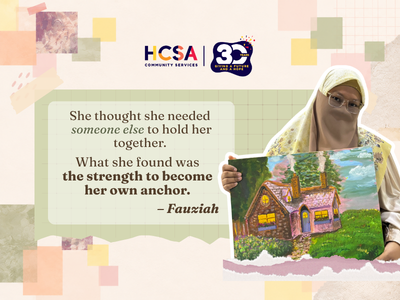
It took Fauziah twenty-three years, many hospital visits and an updated mental health diagnosis before she reached the level of stability and self-understanding she enjoys today.
First diagnosed with Bipolar Disorder in 2001 when she was at university, Fauziah struggled to understand and accept her experiences. During a mental health episode, Fauziah remembers walking through Little Guilin at three o'clock in the morning looking for something she had dropped. Throughout the night, she found herself sitting on staircases, on the roadside curb, at a taxi stand, reciting the Ayatul Kursi. Neither she nor her parents knew what to do.
Years later, following a reassessment of her condition and the publication of the fifth edition of the Diagnostic and Statistical Manual of Mental Disorders (DSM-5), Fauziah received a revised diagnosis of Adjustment Disorder with Depressed Mood, with a secondary diagnosis of Acute Situational Stress. The updated diagnosis helped her better understand her experiences.
After the birth of her second daughter, Fauziah experienced severe postnatal depression. She found it difficult to care for her children during the early years of their lives, but was thankful for her extended family that stepped in to support them. The challenges she faced also took a toll on her marriage, which eventually ended. Fauziah became a single parent. That's when she found SPIN.
Fauziah remembers attending a SPIN-organised carnival and realising that she was surrounded by other single parents who, like her, were doing their best for their families. No one was announcing their circumstances, but there was an unspoken sense of understanding and solidarity. Seeing other single parents with their children gave her hope and confidence for her future.
Today, Fauziah is a mental health advocate and a Social Work Assistant. She remembers fondly the first time her boss had corrected her work - she felt that she was being treated as a valued colleague and trusted professional, rather than being defined by her past challenges. It was a reminder of how far she had come and of the possibilities that can emerge when people are given the opportunity and support to thrive.
Give to the wall